Most lines only get attention when something goes wrong. A part comes back, someone chases down what changed, the line gets steady again, everyone moves on.
That approach works, but it’s expensive, and it’s why you keep seeing the same problems. You’re fixing the symptom on the parts instead of the thing that caused it, so it resurfaces the next time conditions align. And it’s not only your problem. Customers notice too, because consistency is one of the first things they feel.
The way out of that loop is continuous improvement. A few habits that keep a line running where it should: knowing your baseline, holding the chemistry steady, staying ahead on maintenance, and keeping the floor trained. Catching the small stuff early, before it reaches the parts.
Defining the Baseline
A baseline is a full read of your line on a good day, taken while parts are passing and nothing’s wrong yet.
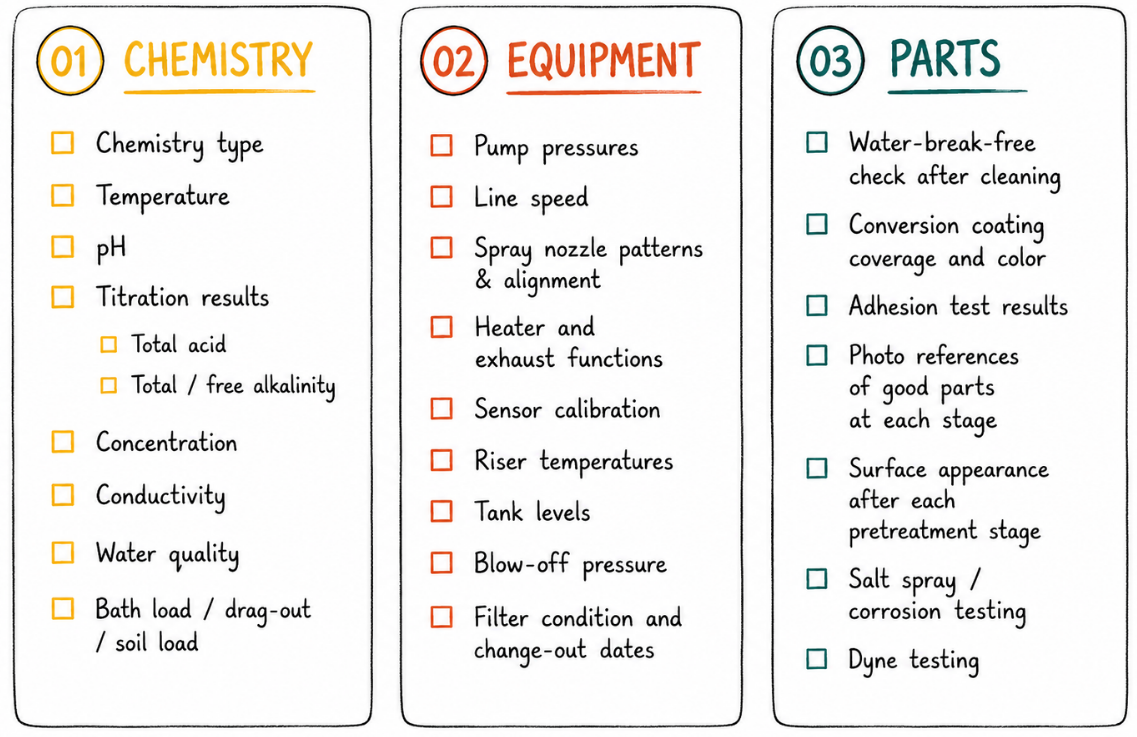
Most plants already have a rough version of this. The operators know what the bath should look like. They know what the pressures normally read and what a good part looks like coming off the line. A baseline is that same knowledge written down, with numbers, on a day the line is behaving. The chemistry, the equipment that delivers it, and the parts themselves.
None of this is on the data sheet. These numbers come off your line. The more of them you capture, the less guessing you do when something drifts.
Here’s what a baseline read covers:
Spec Range Is Not a Baseline
It’s easy to think you already have this. Every chemistry comes with a spec range. It’s the operating window the supplier says the product will perform inside. Concentration between X and Y. Temperature between some minimum and some maximum. It’s printed on the data sheet, and plants often treat it as the target.
The trouble is, that window is wide on purpose. The supplier has to cover every plant, line, part mix and metal type that might run the product, so the range gets built broad enough to work across all of them. Your line runs best in a narrower zone inside it.

The gap between the two is where most problems hide. Once you’ve got a baseline, you can see what changed when a part fails, because you already know what the line looks like when it’s right.
Improvement Is a Habit
A baseline gives you a starting point. It’s not the finish line. The whole idea behind continuous improvement is that a line is never quite done being improved. You establish where it runs right, then you keep it there, and over time you keep tightening, using a little less chemistry, wasting a little less water, holding quality a little steadier.
That’s what makes it continuous. It’s a handful of habits you keep, and the payoff compounds.
Here’s what those habits look like on the floor.
Balancing the TACT Variables
The cleaning stage is a big part of that baseline. It runs on four variables, and together they’re called TACT. The job is keeping them in balance so parts come off clean, shift after shift.
- T – Temperature: Kept near the target cloud point, hot enough to melt soils and drop surface tension, but not so hot it wastes chemistry or so cold it starts foaming.
- A – Action: The mechanical side, usually 20–30 psi in a spray washer. Enough to flush loose soils off the part, not so hard it dislodges parts on the rack.
- C – Concentration: High enough to keep water breaks off the part, low enough that you’re not pouring product down the drain or dragging contamination into the rinse.
- T – Time: Enough contact time for the cleaner to work on the soils, without slowing throughput or etching the more sensitive metals.
Checking these four on a schedule is what keeps a small slip from becoming a bad part. When one does drift, the baseline is what points you to it. Some lines automate this process with a system like SteadyChem™, which monitors the bath around the clock and flags it the moment something moves.
Rule Out the Equipment
When something does look off on a part, the reflex is to reach for the chemistry. Most of the time chemistry isn’t the problem. A clogged nozzle, a misaligned riser, or a pump that’s lost pressure will all show up as a cleaning issue long before the bath is actually out of range. So look at the hardware first. It’s faster to check and it’s usually where the trouble is.
And when you do adjust the chemistry, change one thing at a time, then run a full cycle and see what it did.
Training the Floor
It also helps to have the whole team up to speed, not just the one or two people who’ve always run the line. The more your operators understand what they’re checking and why, the earlier they catch a problem.
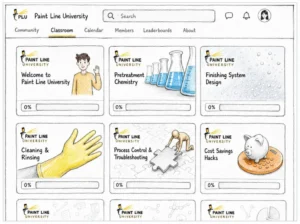
That’s what Paint Line University is for. It’s a free, on-demand pretreatment curriculum built by CPI’s Solution Squad, structured so anyone can go through it. A new hire who’s never run a titration, a supervisor who makes process calls but was never walked through how the chemistry works—everyone gets the same foundation, at their own pace.
Managing the Process Lifecycle
Those habits aren’t one-time fixes. They run on a three-phase loop:
Before Launch (running line audits and trials) → At Launch (tank cleanouts and operator training) → Ongoing (routine benchmarking, spec testing, and regular line audits)
Together they keep the chemistry tuned to the line you’re running.
Not sure where your line stands? That’s what the Solution Squad is for. Bring them in and they’ll go stage by stage through your process, flag what’s drifted, and tell you exactly where to adjust. If something’s costing you more than it should, they’ll find it.
Schedule a time with the Solution Squad.
Frequently Asked Questions
1. How often should I check my baseline numbers?
It depends on the variable and how much your line moves, but concentration and temperature on an active cleaning stage are usually checked at least once a shift, with equipment and part quality on a longer interval. The point is a set schedule rather than a perfect frequency. A line that checks the same things at the same cadence catches a change while it’s small, which is the whole reason to do it.
2. How do I get a baseline if my line has been running for years without one?
You start from where the line is now. Pick a stretch where parts are passing and record the chemistry, equipment, and part results as they stand, then treat that as your working reference and tighten it over time. It won’t be perfect on day one, but a rough baseline you actually wrote down beats a precise one that only lives in an operator’s head.
3. We already have a supplier. Is this worth doing if we’re not switching chemistry?
Yes. Baseline testing, TACT checks, and equipment monitoring are process habits, not products, and they work with whatever chemistry is in your tanks. The consistency comes from how tightly you run the line, not from the brand on the drum. A line audit can show you where things stand regardless of who you buy from.
4. What is SteadyChem™?
SteadyChem™ is a cellular-connected monitoring system that tracks your bath around the clock and flags a change the moment it happens, so you’re not relying on someone getting to a manual check. It handles the consistent monitoring the rest of continuous improvement depends on, and it works with whatever chemistry is running in your tanks, not just CPI products.