There’s a difference between launching products and solving problems. A new product doesn’t mean much if it doesn’t solve something specific on the line. A reformulation doesn’t matter if the constraint a manufacturer is dealing with isn’t in the chemistry — it’s in the process, or in what they can’t see happening between shifts.
Development work that actually moves the needle starts with the problem, not the product — understanding what’s limiting a line right now and building toward it.
That’s how we think about innovation at Circle-Prosco. We stay close to the lines, close to the applications and constraints shifting underneath our customers. When we see a gap between what manufacturers need and what’s available to them, we innovate.
What Drives Development at Circle-Prosco
Manufacturing is constantly evolving. And the chemistry has to evolve with it.
Every new substrate, every tightened regulation, every compressed production schedule creates limitations on real lines. Our development work exists to meet them before they turn into bigger production problems.
A new lubricant solves a chemistry gap. A cleaner-coater that drops into an existing line solves a process gap. A passivation coating that protects brazed aluminum before corrosion sets in solves a durability gap.
That’s what customer-driven development looks like in practice.
Different engineering challenges. Same intent. Remove a constraint that manufacturers are spending time, money, and attention working around instead of running production.
And our process stays the same:
→ Engineer chemistry to fit the line.
→ Move from problem to prototype in weeks, not months.
→ Stay hands-on after delivery. (Development doesn’t end when the drum ships. Technical support is part of how the chemistry performs in the real world.)
The products change. The problems change. The approach doesn’t. Every development cycle points in the same direction: fewer failures, less complexity, better long-term performance.
Here’s a closer look at some of our recent innovations.
Bringing Zirconium to 3-Stage Lines
Three-stage pretreatment lines have a reputation for simplicity. But for operations running traditional iron phosphate, that simplicity comes with trade-offs that most shops have just learned to live with. Dirty sludge building up in tanks and risers. Steel-only substrate limitations. Corrosion performance that hovers around good enough.
Those trade-offs aren’t a 3-stage problem. They’re an old chemistry problem. That’s why we developed Steelcote™ 1750.
SC-1750 is a zirconium-based cleaner-coater designed to bring high-performance pretreatment to simple 3-stage lines (without the high-maintenance hassle). It cleans and coats in a single step and eliminates the trade-offs that come with legacy chemistry:
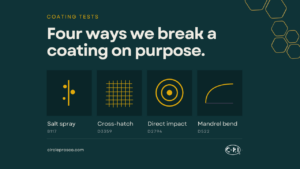
✓ Stronger corrosion resistance than iron phosphate — nanoceramic conversion coating that has outperformed traditional phosphate in accelerated salt spray testing
✓ Multi-metal flexibility — steel, aluminum, and mixed-metal applications instead of steel-only limitations
✓ No phosphate sludge — fewer cleanouts, less waste handling, less downtime
✓ Simpler bath control — managed with pH monitoring and titration, no complex additive schedules
The development goal for SC-1750 was straightforward — give shops running 3-stage systems the pretreatment performance that used to require more stages and more complexity.
Real-Time Visibility, Built for Real Plants
Most small and mid-size manufacturers know their pretreatment baths drift between manual checks. That’s not a surprise to anyone on the floor. The surprise is how long the industry accepted it as normal.
Real-time monitoring has existed for some time — behind SCADA systems, PLC configurations, multi-week installations, and budgets that ruled out most of the plants that needed it most. The technology was there. The access wasn’t.
SteadyChem™ was designed to close that gap. It runs on cellular IoT — no network integration, no IT involvement, no firewall headaches. Subscription pricing instead of a six-figure capital approval. And the customer owns the equipment and the data.
The system runs independently from the plant’s network. Live dashboards, alerts, and exportable data are available from the floor, the office, or anywhere else.
The Bottom Line
None of our work happens in a vacuum. It starts with a conversation — usually with someone who’s dealing with something on their line that doesn’t have a clean answer yet. A chemistry problem. A process problem. Something they’ve been working around long enough that it feels permanent even though it shouldn’t be. That’s the conversation we want to have. Most suppliers sell a formula. We deliver a process.
If you’ve got a problem on your line that doesn’t have a good answer yet — we’d love to help. Reach out to the Solution Squad.
Frequently Asked Questions
- What makes Circle-Prosco’s development process different from standard product development?
Circle-Prosco starts with the line problem first, then builds toward the solution. The team looks at the application, process constraints, substrate, and production environment before developing or adapting the chemistry. - Can Steelcote™ 1750 work in an existing 3-stage pretreatment line?
Yes. Steelcote™ 1750 was developed to bring zirconium-based pretreatment into simple 3-stage lines without requiring a major line overhaul. It cleans and coats in one step, supports multi-metal applications, and eliminates phosphate sludge. - Does SteadyChem™ work with any pretreatment chemistry or only CPI products? SteadyChem monitors bath parameters — not brand-specific chemistry. The system is built to track what matters on the line regardless of what’s running in the tanks.