When’s the last time you evaluated a forming fluid anywhere other than the press?
If the answer is “we check it at the press, it works, we move on”…. you’re not alone. That’s how many plants handle it.
They check lubrication, surface finish, and cost. Then they move on. It’s a perfectly reasonable approach for most forming applications. But on an HVAC line, it’s also how you end up with contamination at your brazing station six months later wondering what on earth went wrong.
Here’s what makes HVAC manufacturing different from almost every other forming application: the press is just the beginning. Parts don’t retire after forming. They head straight into , brazing, welding and assembly, and they bring whatever your fluid left behind right along with them.
That’s why evaluating a forming fluid only at the press never gives you the full picture.
HVAC Forming Fluid Requirements
HVAC lines ask more from a forming fluid than most metalworking applications. Three requirements stand out:
1. Most HVAC forming happens on aluminum…and aluminum is less forgiving
Fins, tubes, and heat exchanger cores are often formed from aluminum, which places tighter demands on fluid chemistry than copper. A fluid that performs well on steel may stain aluminum, affect surface appearance, or create compatibility issues later in the process.
2. Whatever the fluid leaves behind travels with the part
HVAC components move straight from forming into assembly and brazing. Residue that seems harmless at the press can create problems downstream. Sometimes lubricant residues from the fin pack can leak onto cardboard packaging or drain pans, where they degrade the plastic.
3. The facility environment matters
HVAC production facilities are typically enclosed and run at high volume. Operators work in that environment all day. Odor from metalworking fluids and VOC emission are real concerns (ones that surface in safety reviews, operator feedback, and compliance audits). A fluid that smells bad and puts VOCs in the air isn’t going to cut it, no matter how well it lubricates.
We’ve spent years working with HVAC manufacturers, and we kept seeing the same problems show up on line after line. So we built something to fix them.
How Circle-Prosco’s DL-Series Was Engineered to Meet Those Requirements
The DL-Series was built around one simple idea: leaving as little behind as possible.
A lot of forming fluids just sort of… linger. They lubricate at the press and then become someone else’s problem – in the cleaning step or at the brazing station or dripping from the completed heat exchanger onto drain pans or packaging.. DL-Series is a line of thermally degreasable forming fluids built to be completely removed , whether your shop uses heat, solvents, or standard aqueous systems.
That easy-to-clean characteristic cleaner removal helps parts move into brazing and welding in better condition, resulting in more consistent joints. It also means less time spent on cleanup between runs and less contamination carried into downstream operations.
Protect the Tooling, Not Just the Part
A forming fluid should reduce friction, but it should also protect the tools doing the work.
Premature die wear is one of those problems that’s easy to write off as normal. Tooling wears… that’s expected. But how fast it wears often has a chemistry component that gets overlooked. The wrong fluid OR a fluid that’s not matched to the operation, can accelerate wear in ways that show up as inconsistent part quality and higher replacement costs.
The DL-Series is formulated with strong lubricity designed to support both part quality and longer tool life under day-to-day production conditions.
One HVAC manufacturer used CPI Draw Lubes successfully for years. They experienced long die life, excellent fin quality. They changed to a different lubricant and their maintenance increased dramatically, while their thermal degreasing process was significantly degraded. They returned to CPI Draw Lubes.
Chemistry Built Around the Material
Many fluids used on aluminum lines today were originally developed for steel and later adapted. The DL-Series took a different approach. It was designed with aluminum in mind from the start.
As a dedicated aluminum stamping lubricant and non-staining draw lube, DL-Series is formulated to protect aluminum surface quality throughout the forming process. Which means no staining, no residue that discolors fins or tubes, nothing left behind that creates problems when parts move into brazing or coating.
That said, most HVAC lines aren’t running aluminum exclusively. Copper and steel show up regularly, and DL-Series handles both without requiring a fluid change. One chemistry across your material mix.
Performance You Can Document
Performance is one thing, proving it is another. The DL-Series is an ASHRAE 97-tested forming fluid (a test method used to evaluate chemical stability and material compatibility within refrigerant systems). This is not a generic industrial benchmark. It is an HVAC-specific standard intended to answer one question: is this fluid safe to use on the equipment and materials in this industry?
For manufacturers who need documentation for customer requirements, quality audits, or internal standards, ASHRAE 97 testing provides a clear and credible reference point.
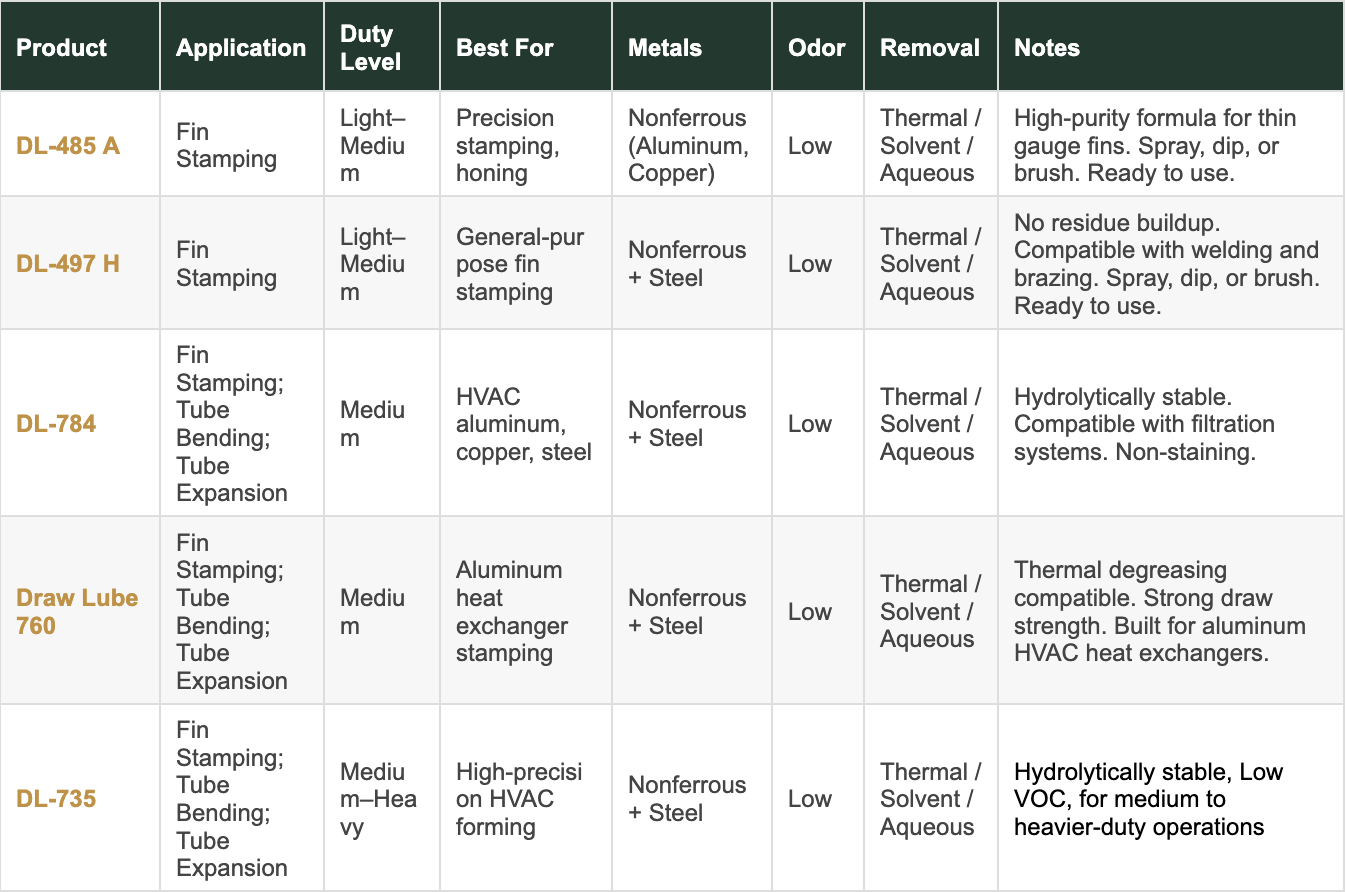
The DL-Series product line
The DL-Series includes five products that cover everything from light fin stamping to heavy-duty tube expansion. All five are low-odor, clean-running, and ready to use out of the container with no mixing required. The differences come down to how hard the fluid needs to work. If you’re stamping thin aluminum fins, you don’t need the same draw strength as someone expanding tubes.
Here’s how they break down:
What Is Your Current Fluid Costing the Line?
Most manufacturers can tell you what they pay per drum. Fewer can tell you what their forming fluid is costing them in cleanup time, tool replacements, rework after brazing, or operator complaints about odor.
If you’re seeing residue issues, shorter-than-expected die life or downstream problems you can’t quite pin down, the fluid is worth a harder look. Get in touch. We’ll figure out which DL-Series product fits your line, send you some samples, and let you see for yourself what changes when the chemistry is actually built for the process.
Frequently Asked Questions
1. Can DL-Series help reduce total manufacturing costs?
Yes, it lowers the total cost of ownership by extending die life, reducing the amount of fluid needed per part, and preventing expensive downstream brazing failures and rework.
2. Does DL-Series work on both aluminum and steel?
Yes, the DL-Series is formulated to handle aluminum, copper, and steel on the same line without requiring a fluid changeover.
3. How cleanly does DL-Series remove before brazing or welding?
It is built to wash off completely. It is thermally degreasable, meaning it evaporates cleanly with a heat gun or a thermal degreasing oven and does not require secondary cleaning prior to brazing or welding.